JavaScript’s ‘this’ Keyword
A commonly used feature of JavaScript is the this keyword, but it is often also one of the most confused and misinterpreted features of the language. What does this actually mean and how is it decided?
This article tries to clear up the confusion and explain the answer in a clear fashion.
The this keyword is not new to those who have programmed in other languages, and more often than not it refers to the new object created when instantiating a class via it’s constructor. For example, if I have a class Boat(), which has a method moveBoat(), when refering to this inside of the moveBoat() method, we are actually accessing the newly created object of Boat().
In JavaScript, we also have this concept inside a function constructor when it is invoked using the “new” keyword, however it is not the only rule and this can often refer to a different object from a different execution context. If you are not familiar with JavaScript’s execution context, I recommend you read my other post on the topic here. Enough talking, let’s see some JavaScript examples:
Whenever you use the keyword this in the global context (not inside a function), it always refers to the global object. Now let’s look at the value of this inside a function:
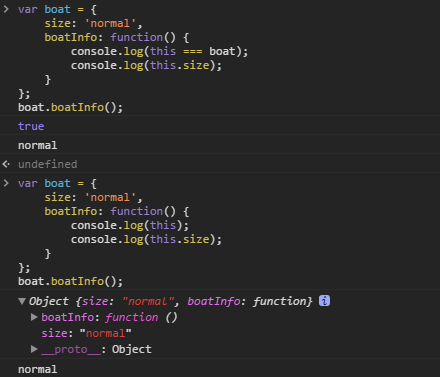
So how is this determined above? We can see an object boat which has a property size and a method boatInfo(). Inside boatInfo(), it alerts if the value of this is the actual boat object, and also alerts the size property of this. So, we invoke the function using boat.boatInfo() and can see that this is the boat object and the size property of the boat is normal.
We then create another object, bigBoat, which has a size property of big. However, the bigBoat object does not have a boatInfo() method, so we copy the method from boat using bigBoat.boatInfo = boat.boatInfo. Now, when we call bigBoat.boatInfo() and enter the function, we see that this is not equal to boat and that size property is now big. Why did this happen? How did the value of this change inside boatInfo()?
The first thing you must realise is that the value of this inside any function is never static, it is always determined every time you call a function, but before the function actually executes it’s code. The value of this inside a function is actually provided by the parent scope in which the function was called, and more importantly, how the actual function syntax was written.
Whenever a function is called, we must look at the immediate left side of the brackets / parentheses (). If on the left side of the parentheses we can see a reference, then the value of this passed to the function call is exactly of which that object belongs to, otherwise it is the global object. Let’s see some examples:
If things are clear this far, then the above code obviously makes sense. We can further complicate things by changing the value of this inside the very same function, by writing the call / invoke syntax in 2 different ways:
Here, we see the value of this inside baz() was different each time, as it was syntactically called in 2 different ways. Now, let’s see the value of this inside a deeply nested object:
Another question often asked is how is the keyword this determined inside an event handler? The answer is this inside of an event handler always refers to the element it was triggered on. Let’s see an example:
|
|
Here we can see that when doAlert() is first called, it alerts undefined, as doAlert() belongs to the global object. We then write myElem.onclick = doAlert, which copies the function doAlert() to the onclick() event of myElem. This basically means that whenever onclick() is activated, it is a method of myElem, meaning the value of this will be the myElem object exactly.
One last thing I want to note on this topic, is that the value of this can also be manually set using call() and apply(), overriding what we have discussed here today. Also of interested is that when calling this inside a function constructor, this refers to the newly created object in all instances inside the constructor. The reason for that is the function constructor is invoked with the “new” keyword, which creates a new object where this inside the constructor always refers to the new object just created.
Summary
Hopefully today’s blog post has cleared up any misunderstanding of the this keyword and you can go forth always knowing the correct value of this. We now know that the value of this is never static and has a different value depending on how the function was invoked.
|
|